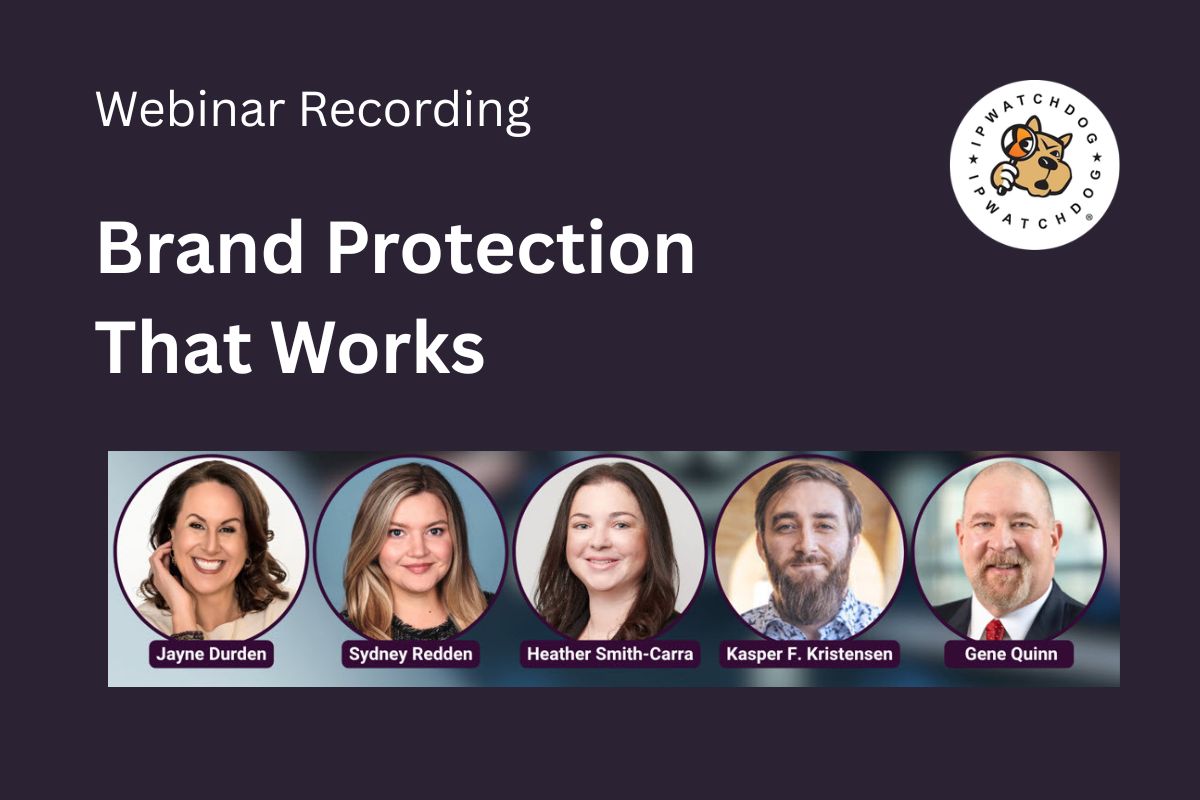
Brand Protection That Works: Moving Beyond Takedowns to Real Impact
Brand Protection | Marken
Juli 1, 2026

By Kasper Frisdahl Kristensen, Program Manager, Brand Protection
I recently joined a panel discussion with Gene Quinn, Founder & CEO at IPWatchdog, alongside Jayne Durden, from Amazon’s Global Brand Engagement team, Sydney Redden, Associate Director of Global External Affairs at IP House, and Heather Smith-Carra, Trademark Attorney and Partner at Banner Witcoff.
Together, we discussed ways to strengthen online brand enforcement, from prioritizing threats more effectively to building stronger evidence and driving faster, more impactful takedowns across channels. Each expert brought a different perspective, but a clear theme emerged: success depends on moving beyond surface-level enforcement toward data-driven threat intelligence.
Infringement is dynamic and happens in real time
Brand protection has never been more complex or important. Today, infringement rarely operates in isolation or stays confined to a single channel; rather, it extends across marketplaces, e-commerce platforms, socials and domain abuse, often working together to drive traffic and sales. Much of the fraudulent activity sits behind what is visible, across opaque environments in which these operations are scaled and organized in ways that are harder to track and take down.
One of the most important starting points is recognizing how interconnected today’s infringement landscape has become. What appears to be a single counterfeit listing is often just a fraction of a broader operation spanning multiple platforms. This creates a fragmented environment where addressing one issue does not resolve the underlying problem.
Without visibility across channels, it becomes difficult to identify patterns, track repeat offenders, or understand where the real risk sits.
Why more takedowns are not the answer
Volume can be an appealing metric. More detections and takedowns can give the impression that things are improving, but in practice, this approach often leads to diminishing returns and fails to tackle the underlying problem.
Not all infringements carry the same level of risk. A one-off listing requires a very different response compared to a coordinated network operating at scale.
Applying the same approach across every channel can be resource intensive and rarely delivers consistent results. What drives better outcomes is prioritization combined with a channel-specific approach. To address this, building channel-specific playbooks is essential to align enforcement activity with how platforms operate. This shift from volume to value is central to delivering meaningful results.
Breaking free from the “whack-a-mole” cycle
The “whack-a-mole” dynamic remains one of the most persistent challenges in brand protection. Listings are removed, only for new ones to appear elsewhere.
Breaking this cycle requires a shift in focus. Rather than focusing solely on removing individual listings, the emphasis should shift to understanding and addressing the networks behind the scenes.
Structured, repeatable workflows play a key role here. By aligning processes with platform requirements, organizations can improve efficiency and increase the likelihood of success.
This involves connecting activity across platforms, identifying patterns of behavior, and building a clearer picture of how infringements are structured. With greater visibility and stronger data, enforcement can become more targeted and impactful, addressing the issue at its root.
Powered by human intelligence
Technology has transformed brand protection, enabling monitoring and detection of potential infringements at scale. AI-driven tools can analyze vast volumes of listings across multiple platforms quickly and consistently, providing a level of visibility that was not previously possible.
However, detection is only the tip of the iceberg.
The challenge lies in interpreting that data and determining how to act on it, combining technology with human expertise. Automation provides reach and visibility, while humans bring context to prioritize effectively.
As I noted during the discussion, “It is the combination of people and technology creating a really strong and accurate outcome.”
Keeping professionals in the loop allows organizations to move beyond surface-level enforcement and toward more strategic decision-making, ensuring effort is invested where it will have the most impact.
Setting strong IP foundations
While strategies and tools continue to evolve, the basics remain the same. Effective enforcement depends on having the right IP in place.
Organizations that invest early in securing and structuring their IP are far better positioned to respond when infringement occurs. Without that foundation, even the most advanced tools have limited capabilities.
As Gene Quinn, Founder & CEO of IPWatchdog emphasized: “There's no damage that is worse than a brand getting damaged right out of the gate, before it has had time to establish itself.”
For growing brands in particular, these early decisions can shape long-term resilience and the ability to enforce effectively at scale.
From reaction to resilience
Ultimately, the goal of brand protection is not just to respond to infringement, but to reduce its impact over time.
Organizations that succeed build visibility across channels, prioritize effectively and develop processes that can scale with their business. They focus not only on addressing individual issues, but on understanding the wider patterns behind them.
The process may feel intimidating, but as Gene Quinn puts it, “The best time to have started doing brand enforcement was yesterday. But yesterday is gone, and you can't get back to yesterday. So, the best time to start is today."
With the right approach, enforcement becomes more than a defensive exercise. It becomes a capability that creates long-term resilience in an increasingly challenging digital landscape, helping organizations reduce impact over time.
Watch the webinar here or contact us to learn more
_______________________________
Explore more on brand protection
If you're interested in building stronger brand enforcement strategies, you may like this additional content:
Weitere Lektüre