2025 AI & IP Trends: How AI is Reshaping the IP Landscape
IA
décembre 18, 2025

Erik Reeves is the Chief Technology Officer at Anaqua. With more than a decade of experience shaping the IP and innovation landscape, Erik is widely recognized as a thought leader in patent search, patent landscaping, IP ecosystem modeling, and big data strategy. As the co-founder and creator of Acclaim IP and FreePatentsOnline.com, he introduced groundbreaking tools that transform usability and speed within the IP industry.
AI is no longer a future concept; it’s a tool for transforming IP today. From patent drafting to portfolio strategy, AI has become a strategic necessity for IP leaders in 2025. Generative AI has shifted from novelty to an operational core, driving legal tech investments and sparking global debates on copyright, inventorship, and liability.
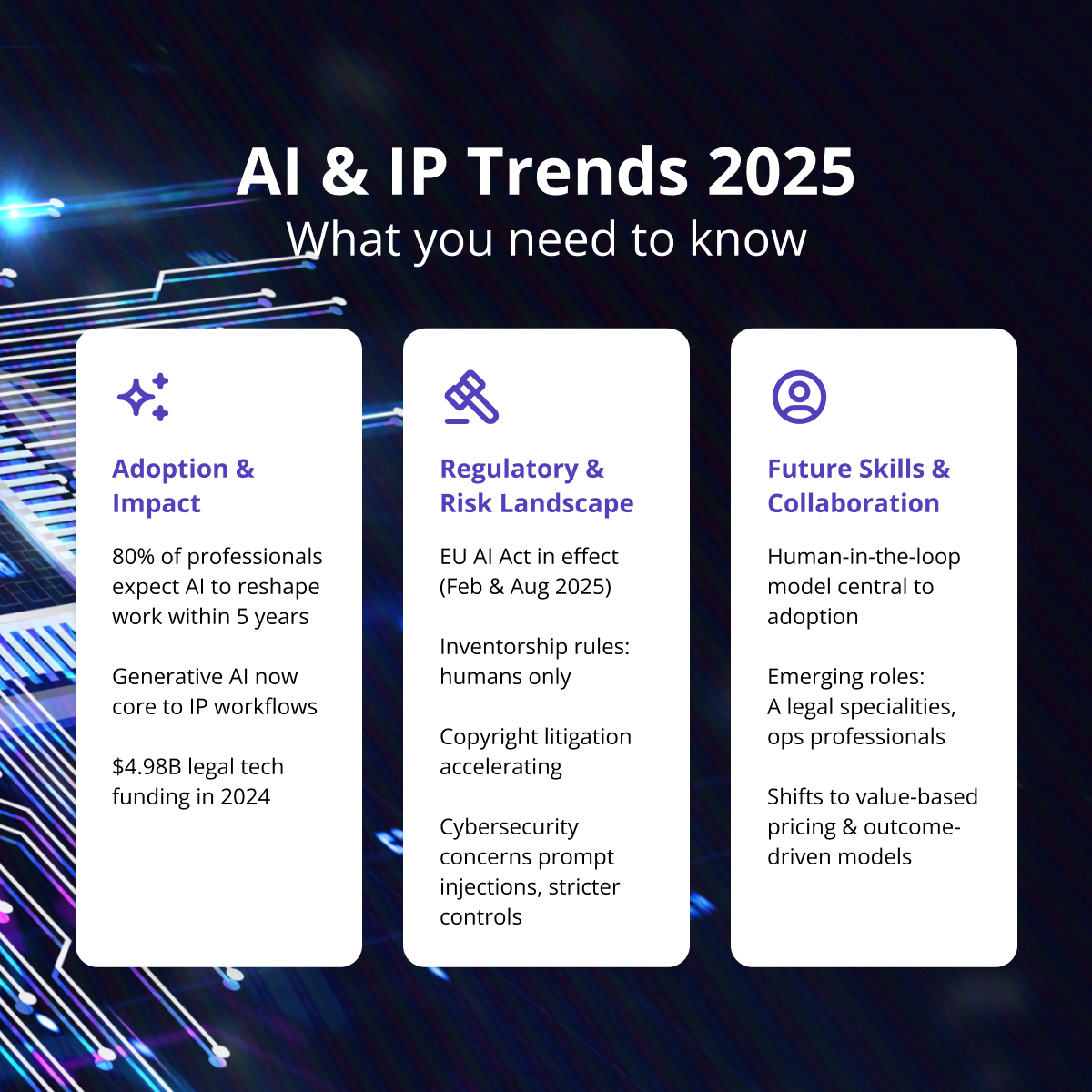
With 80% of professionals expecting AI to reshape their work within five years and patent filings for AI inventions surging, the question isn’t if AI will redefine IP; it’s how fast IP professionals can adapt.
A Snapshot of the State of AI in IP
Following a record-breaking $4.98 billion in legal tech funding in 2024, the IP industry faces unprecedented change. Generative AI is influencing everything from patent drafting to compliance, creating both opportunity and complexity, with 76% of legal departments and 68% of law firms using it weekly. Global patent filings for AI-related inventions are surging, prompting patent offices to update guidelines on inventorship, claim drafting, and disclosure requirements.
To combat this surge, litigation and regulation have risen to meet this incoming wave, with major lawsuits and new regulations addressing ownership of AI-generated works and the legality of training AI on copyrighted material. With cybersecurity and trade secret protection of great concern, AI introduces new risks such as “prompt injections,” driving stricter access controls, security protocols, and regular AI risk audits to safeguard confidential information.
However, with plenty of regulatory uncertainty persisting, global debates continue around liability, inventorship and fair use, with frameworks like the EU AI Act shaping compliance requirements in specific regions. Notably, 2025 marked the year the EU AI Act began to take effect: the first obligations came into force on February 2, 2025, prohibiting certain high-risk practices and uses of AI technology. Starting in August 2025, the Act introduced strict rules and heavy fines for non-compliance, requiring providers, modifiers, and users to ensure transparency and maintain detailed documentation.
What These Trends Mean for IP Leaders
AI integration is no longer optional. With patent filings for AI-related inventions growing rapidly and generative AI embedded in practice, professionals must learn to work with AI copilots and automation tools to remain competitive. Expertise in data science, cybersecurity, and ethical compliance is now essential, as reliance on new skillsets makes continuous learning critical for managing AI-driven workflows.
AI copilots have been used in IP for some time. Now, more advanced autonomous agents offer even greater efficiency by automating and executing routine tasks across the IP spectrum, from drafting and prosecution to analysis and reporting.
Regulatory complexity is creating new challenges for IP professionals. Global standards are shifting rapidly, driven by the EU AI Act, evolving inventorship rules, and copyright debates. Patent offices, including the USPTO, EPO, UKIPO, and JPO, have confirmed that inventors must be natural people, even for AI-assisted inventions. The USPTO requires a “significant human contribution,” while European jurisdictions emphasize the individual who influenced or trained the AI system.
At the same time, copyright litigation is accelerating as courts and regulators examine whether training AI on copyrighted material constitutes fair use or infringement. Staying ahead of these developments and adapting filing strategies is essential to manage risk and maintain compliance.
Meanwhile, the demand for AI solutions for IP management is rapidly increasing with the promise of significant efficiency gains, as lawyers anticipate reclaiming up to 12 hours per week within five years. This isn’t just about technology; it’s about creating space for higher-value contributions.
Human-AI Collaboration: The Next Frontier
The conversation around AI in IP is shifting from fear to opportunity. AI isn’t here to replace human expertise; it’s here to amplify it. The era of IP professionals being buried under manual, repetitive and often low-value tasks is rapidly coming to an end, and by automating these tasks, AI frees professionals to focus on strategic decision-making, complex analysis and creative problem-solving.
This “human-in-the-loop” model is central to responsible adoption. AI depends on human judgment for oversight, ethics, and accountability, capabilities technology cannot replicate. Regulatory bodies and vendors reinforce this principle, framing AI as an assistant, not a replacement. In practice, IP teams can achieve speed and scale while maintaining control and trust.
To thrive in this new era, skillsets must evolve. Legal and technical knowledge remain essential, but they now need to be complemented by AI and data literacy, cybersecurity awareness and an understanding of AI governance. Emerging roles, such as AI-focused legal specialists and legal operations professionals, signal a future where collaboration between law, technology and data science becomes the norm.
This transformation also extends to client relationships and business models. As in-house teams adopt AI to deliver faster, data-driven insights, they expect the same from their external partners. Traditional billing structures are under pressure, with value-based pricing and alternative fee arrangements gaining traction. The measure of success continues to shift from hours worked to outcomes delivered.
Ultimately, AI offers an optimistic vision for IP professionals. It’s not about doing less; it’s about doing more of what matters. By embracing AI as a strategic partner, professionals can elevate their role, deliver greater value and mold the future of innovation.
Looking Ahead: Leading Through Change
The trends shaping this year: rapid AI adoption, regulatory evolution, and rising client expectations, make one thing clear: AI is no longer optional; it’s integral to competitive advantage. For IP leaders, success will depend on embracing AI as a strategic enabler and guiding their organizations through transformation.
Companies must prioritize security, transparency and accountability. By explaining what AI does, its limitations, and how to use it responsibly, with governance to adapt as technology and regulations evolve, you can ensure compliance without stifling innovation.
Rather than replacing entry-level roles, the goal is to equip professionals with AI tools while helping them build domain expertise. This approach ensures future leaders can combine strategic insight, technical capability, and industry knowledge to drive better decisions.
The future of IP is a collaborative model, where AI delivers scale and speed, and human expertise ensures judgment, ethics, and innovation. Acting now means not just keeping pace with a year of unprecedented change but entering 2026 ready to embrace the next wave of transformation with confidence.
Additional resources you may be interested in:
- AI and the corporate IP landscape: strategic transformation and the road ahead
- IP Management and AI: Optimizing the Opportunity and Minimizing the Risk - Anaqua IP Management Software and Services
- Future of Professionals Report 2025
- Stat(s) Of The Week: Record Funding For Legal Tech - Above the Law
- 2024 Future Ready Lawyer Survey Report. Legal innovation: Seizing the future or falling behind? | Wolters Kluwer
- Latest wave of obligations under the EU AI Act take effect: Key considerations | DLA Piper
- Future of Professionals Report: AI Set to Save Professionals 12 Hours Per Week by 2029 - Thomson Reuters Institute
Lecture complémentaire