The IP Operating Model Is Broken: Why Law Firms Can’t Fix It with Billable Hours
KI | Business Management | IP-Strategie
Juli 14, 2026

By Toni Nijm, Chief Product Officer, Anaqua
Ask any Managing Partner at an Intellectual Property (IP) firm what's changed in the last two years, and you'll get a version of the same answer: everything, except the way we work.
Clients are asking harder questions. IP portfolios are becoming more complex. AI is rewriting what "doing the work" means. Yet, most IP law firms are still operating using a model designed for a slower, simpler time—one matter, one system, and one biller at a time.
This approach is no longer sustainable. It's worth asking if you aren’t already: if your firm disappeared tomorrow, would your clients notice the operational difference, or just the invoice?
Your clients have changed faster than you have
Something has shifted in how General Counsels (GCs) talk about outside counsel. It's no longer just "did you win the case" or "did you file on time." It's "show me the value." Boards are pushing GCs to justify every dollar of external spend, and GCs are pushing that pressure straight through to the firms they work with.
The new measure of value
3x
"Value" was mentioned by corporate General Counsels three times more often than a year earlier, reflecting growing focus on efficiency, ROI, business impact, and value delivered by outside counsel 1 .
This isn't a passing budget cycle. It's a permanent recalibration — and the volume of IP work itself keeps climbing, which makes the operational strain worse, not better.
The volume keeps climbing
19.7 million
Global patent filings grew 4.9% in 2024 to reach 3.7 million applications — the fastest annual growth rate since 2018 — with the total stock of patents in force worldwide climbing 6% to an estimated 19.7 million 2.
More IP data, more jurisdictions and more complexity to manage. For firms still running fragmented, manual operations, growth is the thing that breaks the system rather than the thing that proves it works. It raises an uncomfortable question for any firm still billing the way it did a decade ago: if the thing your clients want most is value, why is your fee structure still built around time?
What’s more important to clients: hours spent (billable hours) or value delivered?
Here's the structural problem nobody likes to talk about: an hourly billing model pays a firm for time spent, not value delivered. That's not a moral failing, it's just incentive design — and it means the firm with the most efficient, best-integrated operations has the least financial reason to advertise it.
For example, untangling a docketing error across three disconnected systems takes longer than it would on an integrated platform, and under the billable hour, that extra time becomes extra revenue rather than a cost to fix.
Clients have noticed. They're not just asking for lower rates, they're asking for transparency into what they're actually paying for, visibility into portfolio status without having to request a report, and pricing that reflects outcomes rather than hours logged.
The Shift from Hours to Outcomes
83%
of general counsel say improving efficiency will be a significant part of their legal cost-control strategy over the next 12 months 3.
This doesn't mean the billable hour disappears overnight, or that every matter suits a flat fee. Firms still need to understand exactly what their time is worth and where it goes — that discipline doesn't go away just because the pricing model changes. If anything, firms moving toward alternative fee arrangements need better visibility into time and cost than they did before, not less, simply to make sure a fixed fee is actually priced correctly and still protects margin. The shift isn't away from measuring time. It's away from treating time as the only thing clients are paying for.
AI didn't ask permission, and it isn't waiting
The conversation about AI in legal services has moved past "should we" and landed firmly on "how fast". Prior art review, office action drafting, portfolio analytics, renewal triage: the routine, repeatable layers of IP work are being absorbed by tools that didn't exist three years ago. The pace of change is accelerating faster than most practices have adjusted to.
The role of attorneys is shifting in the AI era, and what they spend their time on is changing completely. The work is moving away from manual drafting and toward judgment, review, and strategic counsel — the things AI genuinely cannot replicate. Firms that treat this as a tooling decision are missing the point. It's a practice redesign question, and the firms answering it well are already pulling ahead of the ones still debating whether to start.
The fragmentation problem hiding behind all of this
Talk to anyone working inside an IP practice, and they'll describe the same daily reality, even if they don't usually say it out loud: a single matter can pass through twelve or more disconnected systems before it's done. One tool for docketing. Another for foreign counsel communication. Another for renewals, etc. Spreadsheets bridging whatever the software doesn't cover. Then a staff member, usually a paralegal, often an associate, spends numerous hours every week just making these systems talk to each other.
That's not simply inefficient. It's a liability sitting in plain sight.
The Cost of Fragmentation
12
The number of systems an IP matter commonly passes through before it's complete.
Docketing. Foreign counsel communication. Prosecution tools. Renewals. Client Reporting. Billing. And more. Spreadsheets bridging the gaps.
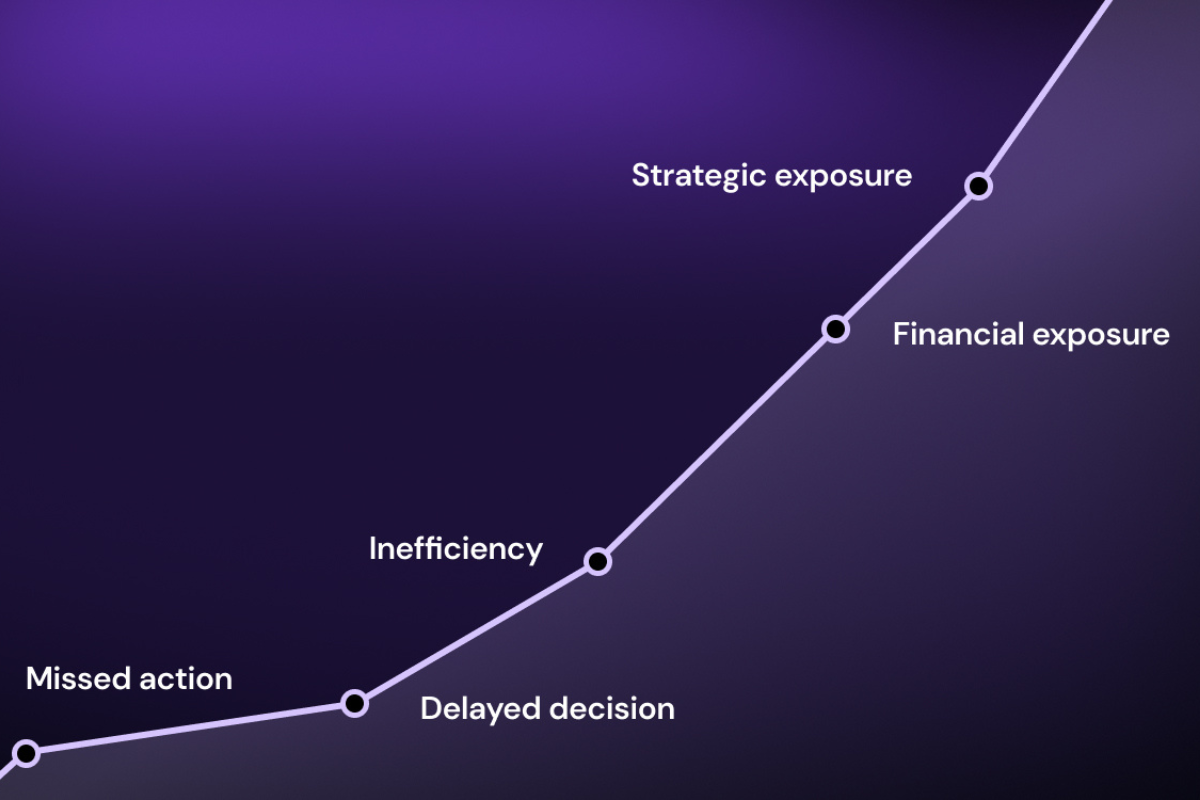
In IP, a missed deadline isn't a procedural inconvenience. It can mean a patent lapses permanently, or a trademark becomes unenforceable. There's no redo button on a missed deadline. The more jurisdictions and the more systems involved, the more exposure firms are quietly carrying. In fact, data suggests that exposure is overwhelmingly a systems problem, not a competence problem.
What separates the firms pulling ahead
The pattern among firms getting this right isn't really about which specific software they bought. It's about a mindset shift: treating operational infrastructure as a source of competitive advantage, not just a back-office cost to minimize.
In practice, that looks like three things happening simultaneously. They've consolidated the systems that used to require manual bridging — docketing, prosecution tracking, and client reporting now living in a connected environment instead of a patchwork of logins. They've turned portfolio data into something they hand to clients proactively, not something they scramble to compile when a client asks for a report. And they've built enough operational capacity to scale so that taking on a new client or a larger portfolio doesn't mean linearly adding headcount.
None of that requires abandoning the practice of law. It requires treating the practice of practicing law as something worth engineering deliberately, rather than something that simply accumulates over years of ad hoc fixes.
Where does your firm stand?
Reading about the shift is one thing. Knowing how to go about making the necessary changes is another. Most partners have a gut sense that something could be tighter, faster, or less exposed to risk — but a gut sense isn't the same as a clear picture.
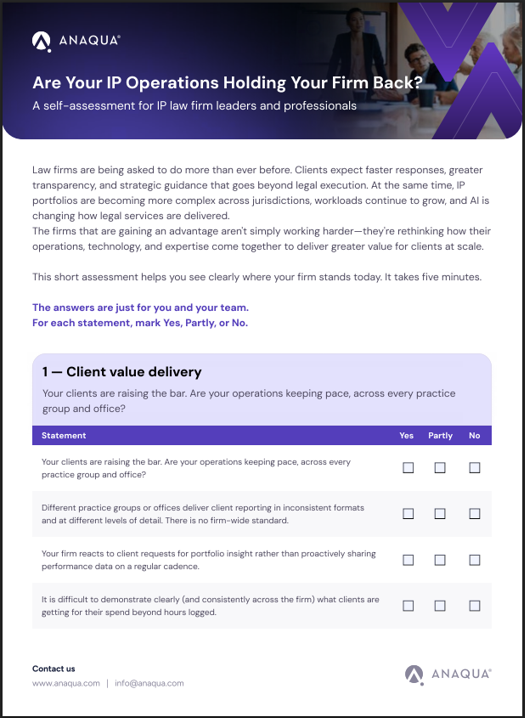
We built a short, practical self-assessment specifically for IP law firm leaders: a few minutes, a handful of direct questions, and an honest read on where your operational gaps actually are — docketing, visibility, scalability, client reporting. No sales pitch. Just a clear-eyed look at where you stand today.
How can Anaqua help you transform your IP operations?
Anaqua helps IP teams and law firms move from fragmented, manual operations to connected, scalable infrastructure that holds up under modern client expectations. The technology isn't the point. What it frees firms to do (advise, strategize, build the relationships that win major mandates) is.
We've put together a deeper look at what operational excellence looks like for IP law firms, and what separates firms compounding their advantage from those falling behind.
The firms that lead tomorrow are fixing their operations today. That shift is already underway, so the only question is whether your firm shapes it or reacts to it once a client or competitor forces the issue.
1 Source: Thomson Reuters Institute, State of the Corporate Law Department Report, 2025, p.3 (based on
2,400+ GC interviews)
2 Source: WIPO, World Intellectual Property Indicators 2025
3 Source: Thomson Reuters Institute, 2024 State of the US Legal Market, Figure 18, p.22
Weitere Lektüre