The Future of IP Operations: Integrating AI, Agents, and Human Judgment
AI
2月 11, 2026
Artificial intelligence (AI) is reshaping the future of IP management by creating new opportunities for teams to work smarter, faster, and with greater impact.
While AI won’t eliminate all the challenges IP professionals face, it can streamline workflows, improve decision-making, and provide deeper insights. It will transform how organizations manage and protect their innovation and IP.
To determine where AI can deliver real value, it’s important to understand how it can enhance—not replace—the expertise of IP professionals.
The First Wave of AI in IP Practice
Early applications of AI in legal and IP work focused on document processing and rule-based automation—optical character recognition, automated templates, and machine translation. These tools improved workflows such as document review and template forms, but the impact was incremental.
The release of OpenAI’s ChatGPT in late 2022 marked a watershed moment, sparking the imagination of how advanced AI could revolutionize the legal profession. Large language models (LLMs) brought capabilities that felt transformative rather than marginal, enabling attorneys and legal professionals to significantly improve how they review, summarize and draft work products.
As both the sophistication of the tools and the skill of users improve, LLM-driven applications are beginning to reshape daily practice—accelerating patent drafting, enhancing prior art research, supporting PTO interaction, and streamlining client reporting. For many professionals, this first wave of advanced AI is already delivering a step change in efficiency and consistency.
The challenge now is to move beyond experimentation and selective use toward structured, enterprise-wide integration that can generate sustained gains across the full scope of IP operations.
The Second Wave–Enter the Agents
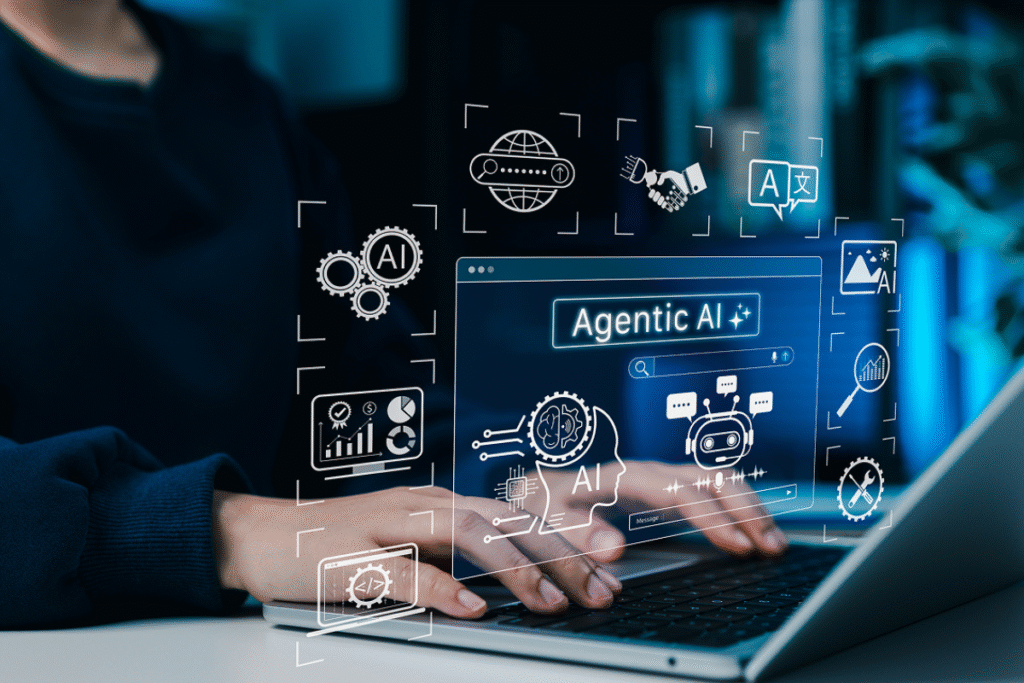
While AI’s first wave transformed attorney work product, the second wave is focused on automating how legal work actually gets done. Agentic AI harnesses the capabilities of LLMs and applies them to reasoning, planning, and autonomous action across workflows. Instead of stopping at drafting or summarization, agents initiate workflows, monitor dockets, categorize documents, and update systems in real time. This marks a fundamental shift: AI is no longer just a desktop assistant supporting professionals, but an active participant embedded in the operational fabric of IP management.
Advances in LLM technologies and models are now orchestrated into systems with both autonomy and authority. By coupling natural language intelligence with decision-making and task execution, agents extend AI’s impact into the core processes that sustain IP operations. They hold the promise of efficiency, accuracy, and scalability by embedding intelligence into tasks once dependent on manual effort. Yet their adoption demands careful governance.
Transparency, reliability, and human oversight are essential to ensure that agentic AI strengthens professional practice rather than introduces new risks. This balance defines both the challenge and the opportunity of AI’s second wave.
Balancing AI and Professional Responsibility
While AI promises a wealth of improvement, it is critical that IP professionals understand its limits—where it is appropriate and capable, and where it is not. Intellectual property is both highly valuable and highly regulated, and decisions made in its management carry financial, competitive, and legal consequences. Professionals in this field are bound by strict standards of conduct and responsibility, including the principle of all due care, which cannot be delegated to machines. Agentic AI can provide efficiency and sharper insight, but the responsibility for final decisions must remain with the human professional.
This is why AI adoption in IP operations increasingly relies on AI-augmented processes rather than full automation. Human-in-the-loop models ensure that AI handles monitoring, categorization, or risk flagging, while attorneys and paralegals validate outcomes and make final determinations. Such an approach allows organizations to benefit from AI’s speed and scalability without compromising on professional oversight.
The objective is not to diminish human expertise but to extend it—empowering professionals to focus on higher-value strategy while ensuring AI does not inadvertently introduce risk. By embedding this balance into workflows, IP teams can achieve both operational efficiency and the level of professional accountability of their clients and stakeholders’ demand.
Toward Integrated AI-First AI Platforms
The future of enterprise IP management lies in combining the strengths of generative AI with the operational power of agentic AI to create fully integrated, AI-first platforms. Generative AI tools enhance attorney work product—drafting, summarizing, translating, and analyzing—while agentic AI automates the workflows that underpin IP operations, from docketing to client reporting to portfolio management. Together, these technologies can reimagine how IP work is conducted end-to-end. Importantly, integration also means embedding human-augmented processes: attorneys and paralegals remain the final reviewers, ensuring that automation operates within the bounds of professional responsibility and delivers work product that meets the highest standards.
Anaqua is at the forefront of this transformation. Its solutions for corporations, law firms, and innovation-driven organizations are rethinking how AI can be deployed across every aspect of IP management. From invention disclosure and patent drafting to docket automation, renewals, and analytics, Anaqua’s IP platforms are designed to orchestrate generative and agentic AI in a unified system.
This approach ensures that efficiency gains are matched with accuracy, compliance, and strategic value—enabling IP professionals to focus more time on innovation and client outcomes while trusting the platform to handle the operational backbone of their work.
The Future of AI in IP Operations
The adoption of AI in intellectual property is advancing quickly and unfolding in waves. The first wave focused on attorney work product, is transforming how legal work is performed—accelerating drafting, research, and reporting. The emerging second wave introduces agents that embed intelligence into the operational core of IP management, automating workflows and enabling systems that reason, plan, and act alongside professionals.
The critical task for IP teams is to harness these innovations while maintaining the professional skill, judgment, and responsibility that define the practice. By striking this balance, the profession can realize the benefits of AI while safeguarding the standards of care on which clients and enterprises rely. Looking ahead, the next wave of AI will likely bring multimodal capabilities, adaptive agents, and cross-enterprise collaboration, creating even greater opportunities for IP organizations prepared to integrate innovation with responsibility.
For IP teams, the imperative is clear.
AI should not be approached as a standalone tool but as an integrated part of enterprise solutions that combine generative and agentic capabilities within human-augmented workflows. This means investing in platforms that can deliver both efficiency and compliance, while creating governance structures that safeguard against risk.
The future of AI in IP will likely bring even greater innovation—multimodal systems that combine text, images, and data; agents that collaborate across organizational boundaries; and platforms that dynamically adapt to new rules and client demands. Teams that embrace this evolution thoughtfully, balancing ambition with responsibility, will not only improve their operations today but position themselves at the forefront of the next wave of AI-enabled innovation in IP.
Interested to learn more about Anaqua's AI solutions?
Additional reading and resources: