AI adoption is accelerating everywhere, and in conversations with IP teams, one theme comes up again and again: it's no longer a question of whether to use AI, but whether your organization is truly ready to use it well. Over the past year alone, organizations have deployed eleven times more AI models into production and dramatically reduced the gap between experimentation and real-world impact. AI has moved from future ambition to operational capability. But progress isn't evenly distributed, and speed without direction often leads to missed value.
In this blog, we'll help you gauge your AI readiness and think practically about what comes next. By looking at readiness through a structured lens, IP leaders can identify gaps, prioritize use cases, and begin shaping a realistic roadmap that turns AI from experiment to sustained advantage.
Step 1: Identify High Impact, Low Risk Starting Points
Before exploring tools or vendors, it's essential to get the foundations right. Effective AI adoption begins with understanding the problem, not the technology. At a time when IP professionals are under ever-increasing pressure to do more with less, and manage larger portfolios without increases in headcount, the obvious starting point is repetitive, high volume, delay prone tasks where the payoff is immediate and the risk is low - essential in an industry that has historically been risk averse.
In IP operations, this often includes predictable, rules-based activities such as data entry, document extraction, or first pass drafting. These manual, time-intensive processes are ideal for early candidates. Starting here frees up capacity, reduces bottlenecks, and helps teams build confidence in AI-supported processes without disrupting critical work.
With its structured workflows and emphasis on accuracy, the IP industry is particularly well placed to benefit from this approach.
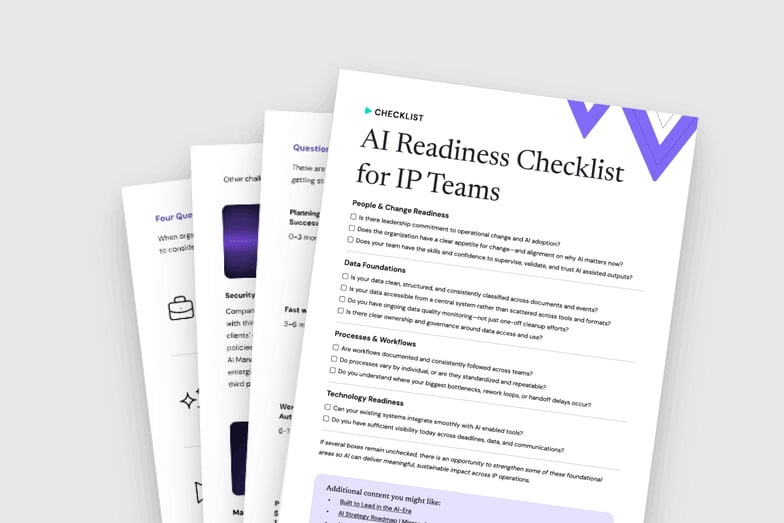
To see where you are in terms of AI readiness, download our AI Readiness Checklist for IP Teams.

Step 2: Decide Whether AI is Actually the Right Solution
Despite its potential, AI isn't the right answer to every problem. Some issues are better addressed through process redesign, improved workflow consistency or clearer ownership. A key principle is to focus on the underlying business challenge. Questions IP teams should ask themselves:
- Where are we losing time?
- Where are errors or inconsistencies creeping in?
- Which tasks create the most risk or administrative overhead?
AI should only be deployed when it adds genuine value by reducing the manual workload, improving the quality of decisions, or increasing accuracy. However, if a workflow is unclear, undocumented, or inconsistent, automating it will simply perpetuate the problem. Strengthening the process first often has a greater long-term impact in these cases.
The IP environment adds another layer of consideration. Any AI-driven change must be transparent, well understood, and fully trusted by the professionals who rely on it. In this context, the role of AI is to enhance expert judgment, not replace it, and it must promote accuracy, not compromise it.
Before moving forward, it's worth pausing on a common trap many organizations fall into.
"Most companies aren't transforming with AI - they're decorating themselves with it. Real adoption starts when you rethink the work itself, not when you add another tool." - Toni Nijm, Chief Product Officer, Anaqua
Step 3: Choosing the Right AI Partner
Once the right use cases are identified, choosing the right partner becomes crucial. In IP, where accuracy and confidentiality are essential, choosing a partner is as much a change management decision as it is a technical one.
The most effective partners understand IP workflows, support gradual adoption, and integrate into existing processes rather than forcing teams into disruptive shifts. The IAPP AI Governance Vendor Report reflects this shift in expectations. Organizations are increasingly prioritizing vendors who not only offer reliable AI capability but also demonstrate mature practices for guiding teams through adoption, ensuring transparency, and supporting sustainable, step-by-step transformation. Companies should also ensure they partner with third partners that do not train on clients' data or that have zero data retention policies and are compliant or working towards compliance with The ISO/IEC 42001 standard for AI Management Systems (AIMS).
Choosing the right partner is ultimately about creating the conditions for successful change: protecting sensitive information, supporting your people through new workflows, and ensuring your AI program grows on a stable, trusted foundation.
Step 4: Avoid Common AI Adoption Pitfalls
With the pace of AI, it's inevitable that teams will make mistakes, but most are avoidable.
A common pitfall is moving too fast. Under pressure to adopt AI, teams often attempt broad transformation before proving value in smaller, safer areas. This "run before you can walk" approach creates avoidable complexity and unnecessary risk, especially in IP, where accuracy and oversight really matter.
Another mistake is adopting AI simply because it's available. As mentioned earlier, AI isn't always the best solution. When teams lead with technology rather than business problems, they end up deploying tools that don't address the real issue or don't align with how people actually work. In these situations, AI becomes a distraction rather than a driver of efficiency.
Oversight is another area where things can slip. As AI becomes more familiar, there's a tendency for people to rely too heavily on outputs and check them less carefully. In IP, where a single missed detail can have serious consequences, human review is vital.
The Connext Global 2026 AI Oversight Report shows that 64% of professionals expect the need for human oversight to increase as AI becomes more embedded in everyday work.
Lastly, organizations often underestimate the risks posed by Third Party partners. Providers without strict data boundaries, clear retention policies or explicit "no training on client data" commitments can inadvertently expose sensitive information. In an industry built on confidentiality and trust, choosing the wrong partner can create long lasting issues that are difficult to undo.
Step 5: Scale Responsibly and Prepare for What's Next
Following initial low-risk wins, the next phase is scaling. Growth should build on what already works, not expand everywhere at once. Most organizations scale in two ways: extending AI across similar tasks and then applying it to deeper, cross team workflows. The strongest results come from reusable patterns, consistent evaluation, and clear governance.
This matters more than ever - recent analysis from the World Economic Forum shows that around 38% of organizations have already operationalized AI use cases at scale, signaling a decisive shift from experimentation to real enterprise deployment.
For IP teams that begin with improving daily administrative work - the "business as usual" tasks benefit most from automation. From there, real transformation comes from connecting workflows across teams and systems, so information can move more intelligently across the business.
Because AI evolves so quickly, no roadmap can remain static for long. Capabilities that seemed cutting edge six months ago can quickly become standard
The Harvard Business Review article "To Scale AI Agents Successfully, Think of Them Like Team Members" notes that deploying AI agents changes how work gets done. This requires organizations to continuously adjust workflows, guardrails, and expectations.
The next major shift will come from agentic systems - AI that can navigate tools, complete multi-step tasks, and trigger actions independently. Anthropic's Cowork is an early sign of this direction: AI operating across files, applications and systems in a way that feels more like a collaborative teammate than a passive assistant.
For IP teams, this opens new possibilities: automated case transitions, proactive deadline management, intelligent portfolio analysis, or preparing filings across multiple systems with far less manual intervention. But it also raises important questions about how comfortable teams are with AI taking initiative, whether governance models can support transparent oversight, and whether partners are ready for this level of autonomy.
A Practical Path for Scaling
Scaling starts with getting the basics right - clean, structured data, aligned workflows, clear ownership and strong controls. From there, teams can deliver quick wins such as summarization, triage, enhanced search, and first pass drafting. Once embedded, AI can support more complex workflows like case matching, routing and exception handling, ultimately creating a foundation for more strategic capabilities.
This reflects how many organizations successfully scale: first, by removing low-value tasks and then by improving handoffs between teams. These are areas where agentic AI will eventually generate the greatest gains by reducing duplication and enabling information to move automatically.
It's important to remember that scaling isn't about doing everything at once. It's about focusing on high impact use cases, equipping teams to use AI responsibly, and maintaining strong oversight, so outputs remain accurate and trustworthy.
AI Readiness in IP Teams
AI is moving fast, and the IP teams that will benefit the most are those who build strong foundations now: clean data, clear workflows, trusted partners, and consistent oversight. With a steady approach, AI becomes a powerful enabler of smarter, more connected IP operations.
Download the E-Book: A New Way of Working - Adopting AI into IP Processes
Additional content you might like: