
The cost of delaying a connected IP system isn’t flat. It compounds.
IP Business Management
August 28, 2026
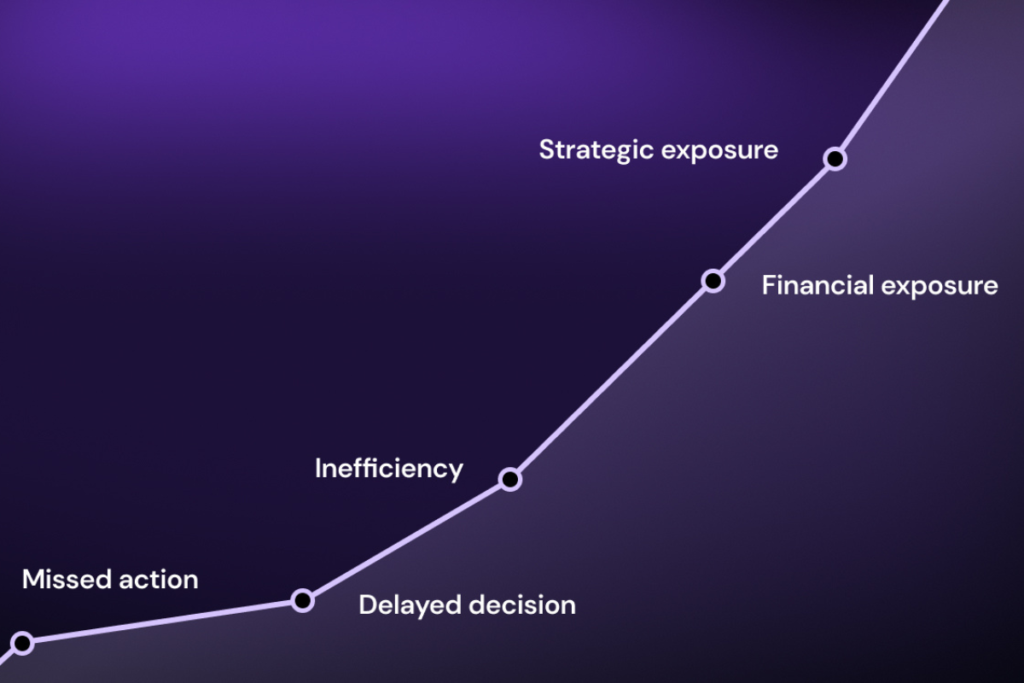
One missed action rarely causes damage on its own. It’s what happens next and next, and next that turns a small gap into real exposure.
Many IP teams are running on setups that were never built for the volume or complexity of the work today. Some are managing renewals, filings, and portfolio strategy across a patchwork of disconnected tools that don’t share data with each other. Others are running IP on a generic CRM platform such as one designed for sales pipelines, not docketing and patent analysis, which also limits how effectively AI can be applied since the underlying data and workflows weren’t built for IP-specific automation. Still others have a system that technically functions but doesn’t match how the team actually work, so people build manual workarounds instead of raising the issue.
None of these situations cause a single dramatic failure. Instead, teams in this position tend to experience something quieter: a renewal deadline flagged a day late, a filing that sits too long, a decision that gets pushed to next quarter. None of it looks urgent in the moment. But stacked up over a year, these small gaps compound into real financial and strategic risk.
Here’s what that escalation actually looks like, stage by stage.
Day 1: Missed action
This looks minor.
A renewal deadline gets flagged a day late. A filing sits in someone’s inbox waiting for a signature. An office action response is drafted but not yet routed for review.
None of this looks like a crisis. It’s the kind of thing that happens in every IP team, every week a single data point in a system that has hundreds of them. Nobody’s watching for the pattern yet.
What’s really happening: The visibility gap that let this slip is still open. Nothing has been fixed. The same gap will produce the same miss again next month, and the month after that.
Month 1: Delayed decision
Someone notices but can’t act quickly.
A team member catches the missed action. But when they go to fix it, the context they need…docket history, correspondence with outside counsel, ownership records, prior decisions lives in three different systems, none of which talk to each other.
What should be a 10-minute fix becomes a multi-day investigation: reconciling records, chasing outside counsel for status, confirming who owns the decision.
What’s really happening: The cost has shifted from “one missed deadline” to “team time lost to manual reconciliation” and the underlying system still hasn’t changed, so the next miss is already forming somewhere else in the portfolio.
Quarter 1: Portfolio inefficiency
Small gaps become standing costs.
Without reliable, centralized portfolio intelligence, decisions that should be reviewed case-by-case start happening by default. Redundant or low-value assets get renewed automatically because no one flagged them for review. Filing errors and jurisdictional mistakes from earlier in the quarter go uncorrected because they’re buried in disconnected records.
What’s really happening: This is where bloated-portfolio risk and overspending compound with missed revenue opportunities. You are now paying to maintain assets that don’t justify their cost, while the team’s attention stays on firefighting instead of strategy.
Quarter 2-3: Financial exposure
The cost stops being hypothetical.
By this stage, the exposure is measurable. Renewal fees on assets that should have been abandoned. Overspend from redundant filings. Lost licensing revenue because monetization opportunities weren’t surfaced in time. In more serious cases: penalties tied to compliance gaps from missed export control or ITAR obligations because manual workflows didn’t catch them.
What’s really happening: This is the point where IP execution risk becomes a line item finance can see and starts asking questions about.
Year 1: Strategic exposure
The damage is no longer just financial.
Slower decisions and reduced portfolio visibility mean competitors move first. They are filing around your unprotected whitespace, out-licensing technology you didn’t know was monetizable, or entering markets faster because your freedom-to-operate analysis lagged behind theirs. Litigation or FTO risk that was invisible for two quarters is now visible to leadership, outside counsel, and possibly regulators.
What’s really happening: Trust erodes with executive stakeholders who are asking why this wasn’t caught sooner, and potentially with customers or partners if the exposure becomes public. At this stage, the fix is no longer a system change. It’s damage control.
The pattern behind every stage
Every stage on this timeline started the same way five stages back: a single missed action, on a system no one was watching closely enough.
This isn’t a scare tactic: it’s math. The cost of outdated, disconnected IP systems doesn’t stay flat. It compounds with every quarter of inaction. The good news is that the earlier you interrupt the pattern, the cheaper the fix.
There’s no time to wait
By the time strategic exposure shows up — competitors filing around your whitespace, litigation risk surfacing, stakeholders asking hard questions — the fix is no longer a system change. It’s damage control. That’s the real cost of waiting: not the missed renewal itself, but everything that gets to build on top of it while nobody’s looking.
The teams that avoid this timeline aren’t the ones with fewer things going wrong. They’re the ones who closed the gap early, before a missed action had room to compound.
If any part of this timeline feels familiar, the moment to act is now, not after the next stage hits.
→ Don’t wait for small gaps to become bigger risks. Request a demo or consult with our team to see how a connected IP system can help you close visibility gaps, reduce manual work, and act before the next stage hits.
Further Reading